PEPTIDE LIBRARY / REFERENCE INDEX
The Peptide Library
A research reference library for individual compounds, mechanisms, terminology, analytical context, and published literature.
Research Profiles
Evidence-focused reference profiles examining individual compounds and the published research surrounding them.

Experimental Tissue-Repair Research
BPC-157
A synthetic pentadecapeptide studied primarily in experimental models of tissue injury, vascular biology, and gastrointestinal protection; controlled human clinical evidence remains extremely limited.
View research profile →

AMYLIN + GLP-1 RECEPTOR AGONISM
Cagrilintide + Semaglutide
A co-administered formulation concept combining cagrilintide and semaglutide; evidence for the combination should be distinguished from evidence for either constituent alone.
View research profile →

GROWTH-HORMONE-RELEASING HORMONE ANALOG / ENDOCRINE RESEARCH
CJC-1295
CJC-1295 is a synthetic growth-hormone-releasing hormone analog developed to extend biological activity through drug-affinity-complex technology. Published human research has examined its pharmacokinetics and effects on growth hormone and IGF-1 concentrations, but clinical outcome evidence remains limited.
View research profile →

GHRH ANALOG + GHRELIN RECEPTOR AGONISM
CJC-1295 (without DAC) + Ipamorelin
A formulation label commonly applied to shorter-acting GHRH analogs combined with ipamorelin; the label should not be treated as equivalent to CJC-1295 with DAC.
View research profile →

Tissue Remodeling / Copper-Binding Peptides
GHK-Cu
A naturally occurring copper-binding tripeptide studied for its role in extracellular-matrix remodeling, cellular repair signaling, skin biology, and wound-healing processes.
View research profile →

FORMULATION / COMPOSITION-SPECIFIC REVIEW
Glow
GLOW is a commonly used name for multi-peptide research formulations. This research profile specifically examines a 70 mg formulation containing 50 mg GHK-Cu, 10 mg BPC-157, and 10 mg TB-500. Because ‘GLOW’ is not a standardized scientific formulation, findings involving individual constituents should not automatically be attributed to the combined blend.
View research profile →

GHRELIN RECEPTOR AGONISM / ENDOCRINE RESEARCH
Ipamorelin
A synthetic growth-hormone secretagogue studied for ghrelin-receptor-mediated endocrine signaling; controlled clinical outcome evidence remains limited.
View research profile →

FORMULATION / COMPOSITION-SPECIFIC REVIEW
Klow
Klow is a formulation name rather than a universally standardized single-compound scientific entity. Its exact composition must be documented before composition-specific claims can be assessed.
View research profile →

MELANOCORTIN RECEPTOR AGONISM / RESEARCH
Melanotan II
A synthetic melanocortin analog studied in receptor pharmacology and limited human research; the evidence base and safety context require careful interpretation.
View research profile →

MITOCHONDRIAL-DERIVED PEPTIDE / METABOLIC RESEARCH
MOTS-c
A mitochondrial-derived peptide studied primarily in cellular, animal, and early human metabolic research.
View research profile →
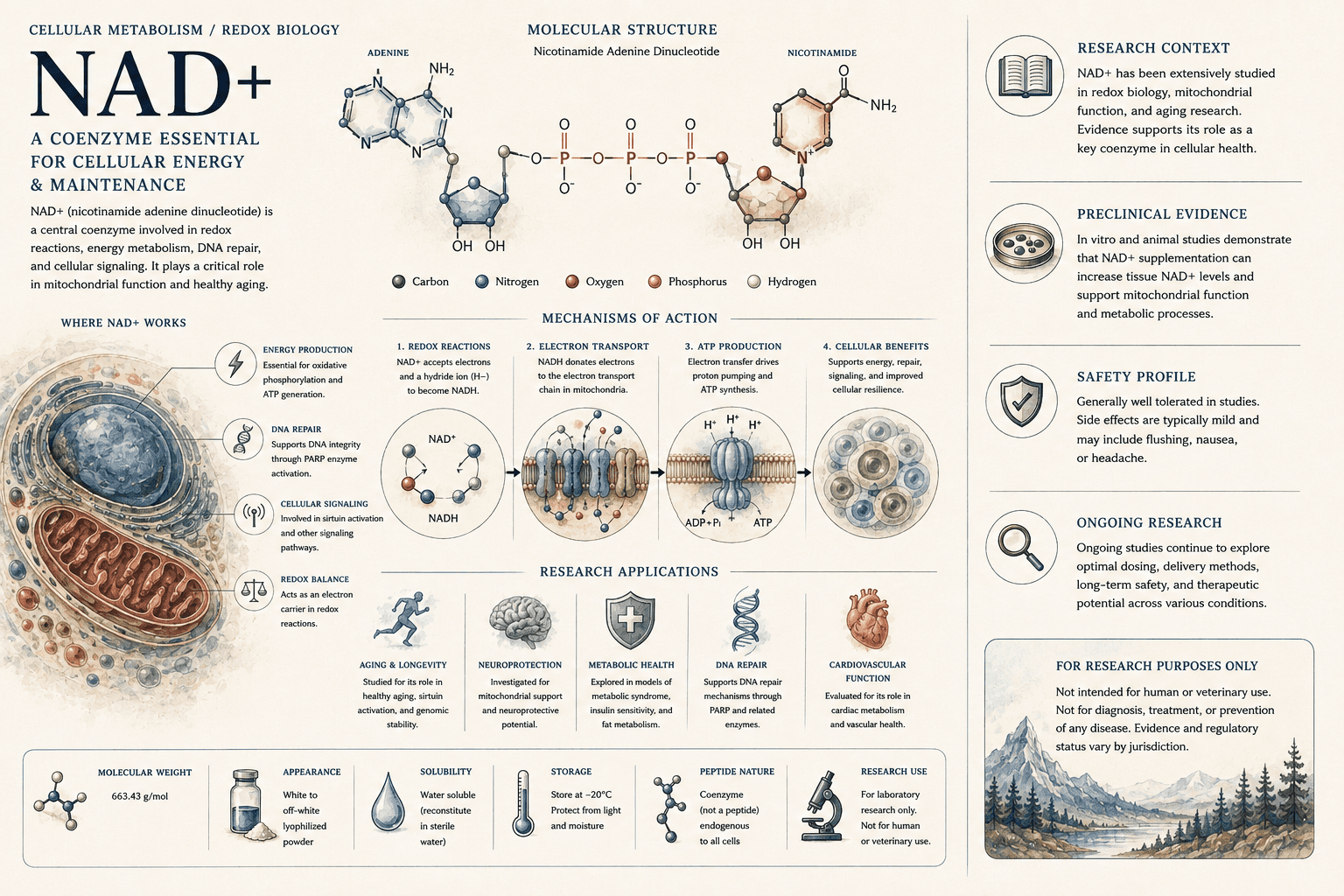
CELLULAR METABOLISM / REDOX BIOLOGY
NAD+
NAD+ is a central cellular cofactor involved in redox metabolism and signaling rather than a peptide. Research should distinguish endogenous biology from formulation-specific intervention claims.
View research profile →

TRIPLE RECEPTOR AGONIST / METABOLIC RESEARCH
Retatrutide
Retatrutide (LY3437943) is an investigational peptide agonist of the GIP, GLP-1, and glucagon receptors. Human clinical trials have examined its effects on body weight, metabolic measures, and safety, with larger clinical-development programs continuing to evaluate its efficacy and longer-term profile.
View research profile →

NEUROPEPTIDE / NEUROLOGICAL RESEARCH
Selank
Selank is a synthetic heptapeptide derived from a fragment related to the naturally occurring peptide tuftsin. It has been investigated for its effects on neurological signaling, stress-response biology, and cognitive processes.
View research profile →

INCRETIN BIOLOGY / GLP-1 RECEPTOR AGONISM
Semaglutide
Semaglutide is a long-acting glucagon-like peptide-1 (GLP-1) receptor agonist studied extensively in metabolic, body-weight, glycemic, and cardiovascular research.
View research profile →

NEUROPEPTIDE ANALOG / NEUROSCIENCE RESEARCH
Semax
A synthetic peptide analog investigated in neuroscience and neuropharmacology research, with evidence varying substantially by model and setting.
View research profile →

GROWTH-HORMONE-RELEASING HORMONE ANALOG / ENDOCRINE RESEARCH
Sermorelin
Sermorelin is a synthetic 29-amino-acid amidated fragment of human growth hormone-releasing hormone, commonly described as GHRH(1-29)-NH2.
View research profile →

MITOCHONDRIAL-TARGETED PEPTIDE / CLINICAL RESEARCH
SS-31
SS-31, also known as elamipretide, MTP-131, and Bendavia, is a mitochondria-targeted tetrapeptide investigated for interactions with the inner mitochondrial membrane and mitochondrial function.
View research profile →

THYMOSIN BETA-4 FRAGMENT / TISSUE-REPAIR RESEARCH
TB-500
TB-500 is an acetylated seven-amino-acid fragment corresponding to residues 17–23 of thymosin beta-4. Direct evidence specific to TB-500 is limited, and findings from full-length thymosin beta-4 should not be treated as interchangeable evidence.
View research profile →

GROWTH-HORMONE-RELEASING HORMONE ANALOG / METABOLIC RESEARCH
Tesamorelin
A synthetic GHRH analog investigated in endocrine and metabolic research, with controlled human evidence in defined clinical populations.
View research profile →

INCRETIN BIOLOGY / DUAL-RECEPTOR AGONISM
Tirzepatide
Tirzepatide is a synthetic peptide that activates both glucose-dependent insulinotropic polypeptide and glucagon-like peptide-1 receptors. Its clinical research program has examined glycemic regulation, appetite, body-weight change, cardiometabolic outcomes, and long-term weight maintenance.
View research profile →