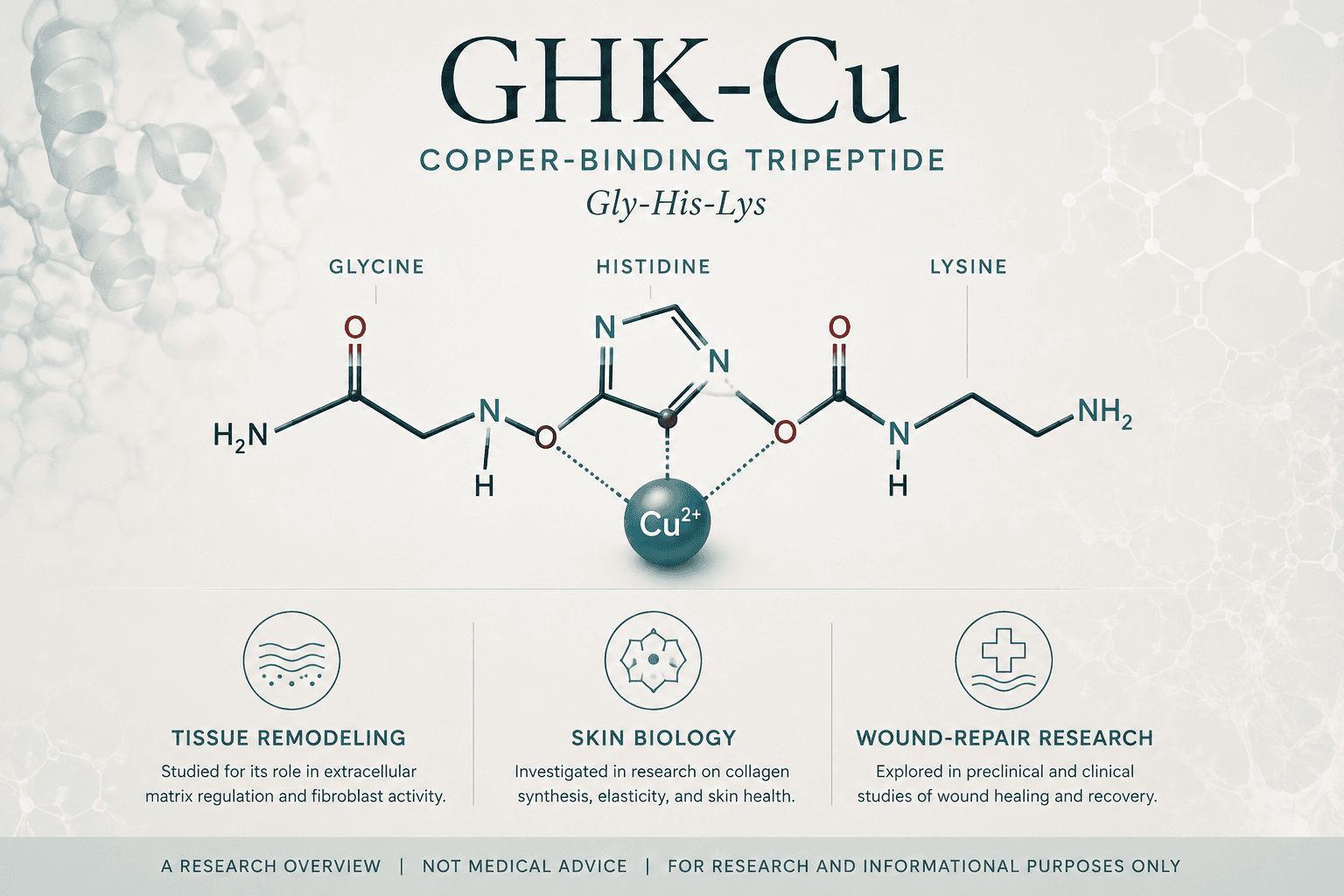
What is GHK-Cu?
GHK-Cu is a copper-binding complex formed by the naturally occurring tripeptide GHK—glycyl-L-histidyl-L-lysine—and copper(II).
GHK was originally identified in human plasma and has subsequently been studied for its interactions with copper and its potential involvement in tissue remodeling and repair-related biological processes. Research has also identified GHK in other biological fluids, including saliva and urine.
The distinction between GHK and GHK-Cu is important. GHK refers to the three-amino-acid peptide itself, while GHK-Cu refers to the complex formed when that peptide coordinates a copper ion. Experimental work examining GHK and related compounds suggests that copper complex formation is relevant to at least some of the peptide's observed biological activity.
Because copper participates in numerous biological processes, GHK-Cu has attracted research interest across several areas, particularly extracellular-matrix remodeling, fibroblast biology, skin biology, and wound-repair models.
However, the breadth of research surrounding GHK-Cu should not be confused with equivalent levels of evidence for every proposed application. The literature includes mechanistic experiments, cell studies, animal models, reviews, and a more limited body of human research.
Why copper binding matters
Copper is an essential trace element involved in numerous biological processes, including enzyme activity, connective-tissue biology, and cellular signaling.
GHK has a strong affinity for copper(II), forming the complex commonly referred to as GHK-Cu. This interaction is more than a naming detail: experimental research suggests that copper complexation can influence the biological behavior observed with the peptide.
For example, early fibroblast research found that GHK-Cu stimulated collagen synthesis in cultured cells. Other experiments reported effects on glycosaminoglycan production and components involved in extracellular matrix remodeling.
One study examining matrix metalloproteinase-2 found that GHK-Cu increased MMP-2 expression in cultured fibroblasts, while GHK without copper did not reproduce that particular effect. The researchers also observed changes in TIMP-1 and TIMP-2, proteins involved in regulating extracellular matrix turnover.
These findings help explain why GHK-Cu is frequently discussed in the context of tissue remodeling rather than simply collagen production. Remodeling involves a coordinated balance between producing, organizing, and breaking down extracellular matrix components.
However, these mechanistic findings primarily tell us about biological activity under experimental conditions. They should not automatically be interpreted as evidence of a specific therapeutic effect in humans.
What the research says about skin and connective tissue
Much of the interest in GHK-Cu comes from research examining its interaction with fibroblasts and the extracellular matrix.
Laboratory studies have reported increased collagen synthesis in fibroblast cultures exposed to GHK-Cu. Other experimental work has examined effects on glycosaminoglycans, matrix metalloproteinases, and their inhibitors—processes involved in the ongoing formation and remodeling of connective tissue.
This provides a plausible biological basis for studying GHK-Cu in skin and tissue-repair contexts. However, mechanistic activity in cultured cells is not the same as demonstrated clinical benefit in humans.
The human evidence is considerably more limited and should be interpreted accordingly. In one randomized study of 13 patients following CO₂ laser resurfacing, topical GHK-Cu did not produce statistically significant improvements in objectively measured redness, wrinkles, or overall skin quality compared with the control regimen. Patient-reported satisfaction was higher in the GHK-Cu group, but the objective measures did not show a corresponding advantage.
More recent laboratory and ex-vivo research continues to investigate GHK-Cu's effects on different collagen types and extracellular matrix biology, but these models still do not establish the magnitude of an effect in living humans.
This distinction is important because GHK-Cu is frequently associated online with broad claims about skin rejuvenation. The published literature supports biological activity worthy of continued investigation, but the strength of evidence varies substantially depending on the specific claim being considered. A recent review of topical GHK likewise noted that published information concerning factors such as skin permeability and effectiveness remains insufficient.
GHK-Cu and wound-repair research
Wound-repair biology is one of the longest-studied areas associated with GHK-Cu.
In an animal wound model, researchers reported that GHK-Cu increased the accumulation of several extracellular matrix components, including collagen and glycosaminoglycans. The study also observed changes in type I and type III collagen gene expression, providing evidence that GHK-Cu can influence connective-tissue processes during experimental wound repair.
Subsequent research examined how GHK-Cu affects the remodeling phase of wound healing. Studies in experimental wounds and cultured fibroblasts reported changes in matrix metalloproteinases and related regulatory proteins, suggesting that its activity may involve both extracellular matrix production and remodeling rather than simply stimulating collagen formation.
Researchers have also reported effects on glycosaminoglycans and proteoglycans—molecules that contribute to the structure and organization of the extracellular matrix.
However, the results are not uniformly positive across experimental models. A later study using irradiated rat wounds found no significant improvement in several measured wound-healing outcomes with topical GHK-Cu compared with control treatment.
Taken together, the literature supports continued investigation of GHK-Cu in wound biology, but it does not justify treating wound healing as an established human therapeutic effect. Much of the evidence remains preclinical, and results can depend heavily on the experimental model, formulation, and outcome being measured.
What about the broader claims surrounding GHK-Cu?
GHK-Cu is associated online with claims extending far beyond skin and wound biology. These include anti-inflammatory effects, antioxidant activity, lung protection, neurological effects, anti-aging activity, and even anticancer properties.
There is published research behind some of these research directions, but the level of evidence varies considerably.
For example, GHK has been identified through gene-expression analysis as a compound capable of reversing aspects of an emphysema-associated gene-expression signature. In laboratory experiments, GHK also helped restore collagen contraction and remodeling in fibroblasts obtained from patients with chronic obstructive pulmonary disease. (pubmed.ncbi.nlm.nih.gov)
More recent animal research has reported anti-inflammatory and antioxidant effects of GHK-Cu in cigarette-smoke-induced pulmonary emphysema models. (pubmed.ncbi.nlm.nih.gov)
Researchers have also investigated gene-expression changes associated with GHK. Reviews of these data have proposed effects across numerous biological pathways involving inflammation, oxidative stress, tissue repair, and cellular regulation.
However, gene-expression changes and effects in cells or animal models are not equivalent to demonstrated clinical outcomes in humans.
This distinction becomes particularly important with some of the most ambitious claims surrounding GHK-Cu. Anticancer effects, neuroprotective effects, and systemic “anti-aging” effects have been proposed from laboratory, computational, and preclinical findings, but these areas remain investigational. Some cancer-related literature, for example, involves gene-expression analysis and mouse experiments rather than controlled human cancer trials.
The scientifically appropriate conclusion is therefore not that these broader effects have been established, but that GHK-Cu interacts with biological pathways that continue to generate research questions well beyond skin biology.
What we still don't know about GHK-Cu
Despite decades of experimental interest, several important questions surrounding GHK-Cu remain unresolved.
One of the largest gaps is the amount of high-quality human clinical evidence. Much of the literature consists of cell experiments, animal models, mechanistic studies, and reviews. Recent clinical reviews continue to describe the evidence for unapproved peptide applications such as GHK-Cu as limited compared with established therapies.
Delivery is another unresolved issue. GHK-Cu is relatively hydrophilic, while the outer layer of skin creates a substantial barrier to penetration. Recent research continues to investigate formulations such as liposomes specifically because getting GHK-Cu to its intended site of action is itself an important scientific problem.
A 2025 review of topical GHK found a notable shortage of clinical studies and concluded that published information regarding effectiveness, skin permeability, and other important formulation characteristics remains insufficient.
Important unanswered questions therefore include:
How well do different formulations deliver GHK-Cu to relevant tissues?
Which biological effects observed in laboratory models translate meaningfully to humans?
What exposure levels are required to produce those effects?
What does long-term safety look like for different routes of exposure?
Which proposed applications ultimately survive rigorous controlled clinical testing?
These uncertainties don't erase the experimental findings surrounding GHK-Cu. They define the next stage of the research.
The interesting story of GHK-Cu is not that science has already established everything attributed to it online. It is that a remarkably small copper-binding peptide has produced enough biological signals to keep researchers asking new questions decades after its discovery.
Evidence snapshot
Mechanistic / laboratory evidence: Substantial
Animal evidence: Moderate
Human clinical evidence: Limited
Research history: Several decades
Established human therapeutic uses: Not established
Major research areas: Skin biology, extracellular matrix remodeling, wound repair, inflammation, and tissue regeneration
The evidence surrounding GHK-Cu is unusual because the compound has been studied for decades and demonstrates biological activity across numerous experimental systems, yet the human clinical evidence remains much less developed than its popularity might suggest.
Recent reviews continue to describe promising findings in wound repair and skin biology while highlighting unanswered questions involving clinical effectiveness, formulation, stability, and tissue delivery.
The bottom line
GHK-Cu is more than an internet skincare trend. It is a naturally occurring copper-binding tripeptide with a substantial research history and documented biological activity involving fibroblasts, extracellular matrix components, tissue remodeling, and wound-repair pathways.
At the same time, the evidence is not equally strong for every claim associated with GHK-Cu.
Some of the most compelling findings come from cell experiments and animal models. Human research exists, but it is considerably more limited, and important questions remain about formulation, delivery, long-term effects, and whether broader findings translate into meaningful clinical outcomes. Recent work on liposomal delivery illustrates that even getting GHK-Cu through the skin barrier efficiently remains an active research question.
The most accurate description of GHK-Cu is therefore neither “proven anti-aging miracle” nor “unsupported hype.”
It is a small, biologically interesting copper-binding peptide with a surprisingly broad experimental literature—and a substantial amount still left to learn.