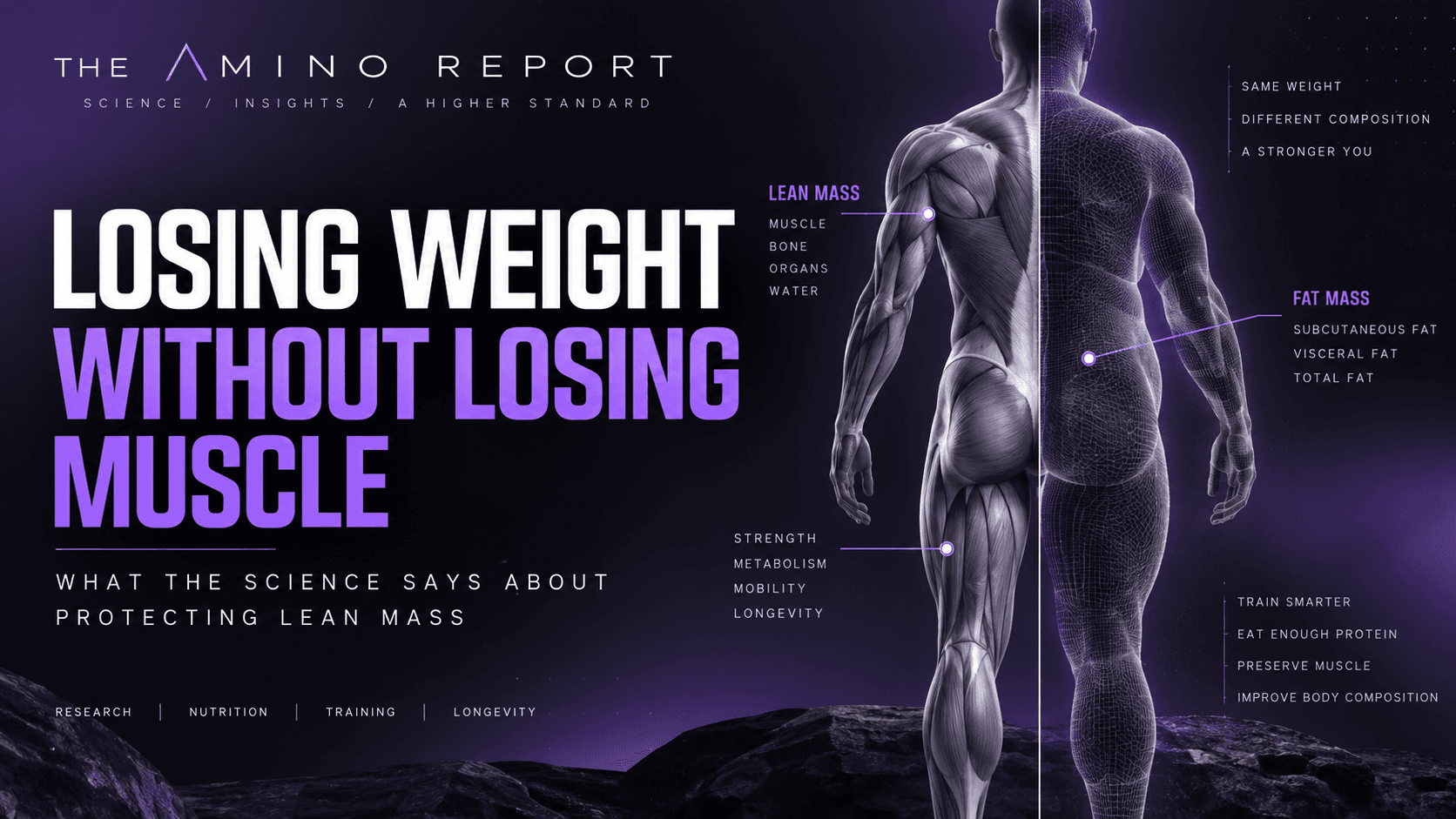
Losing Weight Is Not the Same as Losing Fat
When most people talk about weight loss, the scale gets all the attention. Lose 10, 20, or 30 pounds and the assumption is that the goal has been accomplished.
But the scale cannot tell you what you actually lost.
Body weight includes fat, muscle, water, bone, organs, and other tissues. During significant weight loss, the body typically does not draw exclusively from stored body fat. Some lean tissue can be lost as well.
That distinction matters.
For someone trying to improve body composition, the ideal outcome isn't simply becoming lighter. It's losing as much excess fat as possible while preserving muscle, strength, and physical function.
And as modern weight-loss therapies make larger reductions in body weight increasingly achievable, researchers are paying much more attention to this question.
How Much Lean Mass Can Be Lost During Weight Loss?
There isn't one percentage that applies to everyone.
The amount of lean mass lost can vary substantially depending on the size of the calorie deficit, starting body composition, age, activity level, protein intake, resistance training, the amount of total weight lost, and how body composition is measured.
Recent research helps put the issue into perspective.
A 2026 meta-analysis examined 20 randomized controlled trials involving 15,782 participants. Researchers compared body-composition changes during intensive lifestyle interventions and treatment with incretin-based therapies including semaglutide, tirzepatide, and liraglutide.
Across the studies, a meaningful portion of total weight loss came from lean mass. Interestingly, the proportion was broadly comparable between incretin therapies and lifestyle-based weight loss overall.
One group stood out: people whose lifestyle intervention included resistance training showed the most favorable lean-mass preservation.
That finding reinforces an important point:
The goal shouldn't necessarily be to prevent every ounce of lean-mass loss. The goal is to improve the quality of the weight being lost.
Muscle Is More Than Appearance
Preserving muscle isn't only about looking athletic.
Skeletal muscle contributes to strength, mobility, glucose disposal, physical independence, and the ability to perform everyday activities. Maintaining adequate muscle becomes increasingly important as we age because aging itself is associated with gradual changes in muscle mass and function.
This means two people can lose the same amount of body weight yet finish with very different body compositions.
Imagine two people who each lose 30 pounds.
One preserves most of their muscle while losing predominantly fat. The other loses considerably more lean tissue along with the fat.
The scale reports the same result.
Their bodies may not.
Resistance Training May Be the Most Important Signal
If preserving muscle during weight loss is the goal, resistance exercise has some of the strongest evidence behind it.
A 2025 systematic review and meta-analysis examined 25 randomized controlled trials in adults with overweight or obesity undergoing dietary weight loss.
Adding resistance exercise did not produce dramatically greater total weight loss than dieting alone.
But that's precisely why the findings are interesting.
People performing resistance exercise preserved more fat-free mass, lost more fat mass, and improved muscular strength compared with diet-only groups.
In other words, the scale didn't necessarily move much more.
Body composition did.
Resistance training provides the body with a repeated physiological reason to retain muscle tissue even when energy intake is reduced.
That can make strength training particularly valuable during periods of substantial weight loss.
Protein Provides the Raw Material
Training provides a stimulus. Nutrition provides the building blocks.
Dietary protein supplies amino acids required for muscle protein synthesis and tissue maintenance. During an energy deficit, adequate protein intake may become especially important because the body is simultaneously being asked to operate with less available energy.
A 2024 systematic review and meta-analysis examining adults with overweight or obesity found that enhanced protein intake was associated with better preservation of muscle mass during weight loss.
That doesn't mean simply eating enormous amounts of protein guarantees muscle preservation.
Total calorie intake, food quality, training status, age, kidney function, overall health, and individual protein needs still matter.
But taken together, current evidence supports a fairly intuitive combination:
Give muscle a reason to stay through resistance training—and provide the nutritional resources needed to maintain it.
Does Faster Weight Loss Mean More Muscle Loss?
This question is more complicated than it sounds.
A very aggressive energy deficit can make it harder to meet nutritional needs and may increase the challenge of maintaining training performance. But the relationship between rate of weight loss and muscle loss isn't governed by one universal threshold.
Starting body composition matters. Training matters. Protein matters. Age matters. And the magnitude of weight loss matters.
Rather than assuming that faster is always worse or slower is always better, researchers increasingly look at the entire weight-loss environment.
Someone losing a substantial amount of weight while resistance training and consuming adequate nutrition may have a very different outcome from someone achieving the same scale loss with severe calorie restriction and little physical activity.
This is another reason body composition can provide information that body weight alone cannot.
What About GLP-1 and Incretin-Based Weight Loss?
The rapid adoption of GLP-1 and related incretin therapies has brought the muscle-loss question into the spotlight.
Medications such as semaglutide and tirzepatide can produce substantial reductions in body weight. Investigational compounds targeting additional metabolic pathways are also being studied.
Because the amount of weight lost can be significant, researchers have questioned how much of that reduction represents fat versus lean tissue.
The answer requires some nuance.
A 2026 meta-analysis found that lean mass represented approximately 25% to 39% of total weight lost across the incretin therapies examined. However, lifestyle-based weight loss also resulted in lean-mass reductions, and the overall proportion was not significantly different from incretin therapy in that analysis.
Another 2026 systematic review found considerable variability between studies and measurement methods, while confirming that incretin-associated weight loss generally included large reductions in fat mass and visceral fat alongside some reduction in muscle-related measures.
So saying that “GLP-1 medications cause muscle wasting” oversimplifies the evidence.
A more accurate interpretation is that substantial weight loss—whether achieved through lifestyle intervention, medication, or other methods—can include lean tissue loss.
The increasingly important question is how that lean tissue can best be preserved.
The Scale Can Hide Progress
One of the most interesting lessons from resistance-training research is that better body composition doesn't always produce a dramatically better number on the scale.
Consider someone who loses:
18 pounds of fat and 2 pounds of lean mass
versus someone who loses:
14 pounds of fat and 6 pounds of lean mass.
Both lost 20 pounds.
But those are very different outcomes.
This is why scale weight alone can sometimes underestimate progress from resistance training. Someone preserving or even gaining muscle while losing fat may see slower changes in total body weight despite substantial improvements in body composition.
Waist circumference, strength, clothing fit, progress photographs, and validated body-composition measurements can provide additional context.
No single measurement is perfect, but together they can tell a much more useful story than scale weight alone.
A New Question for the Weight-Loss Era
For decades, weight-loss success was largely defined by a single metric:
How many pounds did you lose?
The next generation of obesity and metabolic research is beginning to ask a more sophisticated question:
What did you lose?
As therapies become capable of producing increasingly large reductions in body weight, preserving muscle may become an important part of evaluating the quality—not simply the quantity—of that weight loss.
Current evidence points toward several recurring factors: resistance exercise, adequate nutrition and protein, maintaining physical activity, and paying attention to body composition rather than relying exclusively on the scale.
There is still much that researchers don't know.
We don't yet have perfect answers about the optimal strategy for every person, how different weight-loss therapies compare over many years, or how changes measured as “lean mass” translate into long-term physical function.
But one principle is becoming increasingly difficult to ignore:
The best weight-loss outcome may not be the person who loses the most weight. It may be the person who loses the most excess fat while keeping as much useful muscle as possible.